Low Fertility and the Rise of the “Perfect Child”
East Asia is experiencing a profound demographic transformation, with fertility rates remaining below replacement level for decades in societies such as China, Japan, South Korea, Taiwan, Singapore, Hong Kong, and Macau. At the same time, assisted reproductive technologies (ART)—including in vitro fertilization (IVF), preimplantation genetic testing (PGT), and emerging embryo genetic screening—are advancing rapidly. These trends may seem unrelated: one reflects having fewer children, while the other focuses on helping people have children. Yet they may increasingly intersect as families have fewer children but place greater expectations on each one.
In many East Asian societies, children are closely associated with family continuity, social mobility, and parental achievement. Intense educational competition and “tiger parenting” encourage parents to invest substantial financial and emotional resources in their children's education and future success. This has contributed to a culture of “child perfectionism,” in which parents feel pressure to raise children who achieve the best possible outcomes. Ironically, the high costs and expectations associated with raising a successful child may itself discourage couples from having additional children—or from having children at all. The result is a demographic paradox: fewer children, but greater investment and expectations placed on each child.
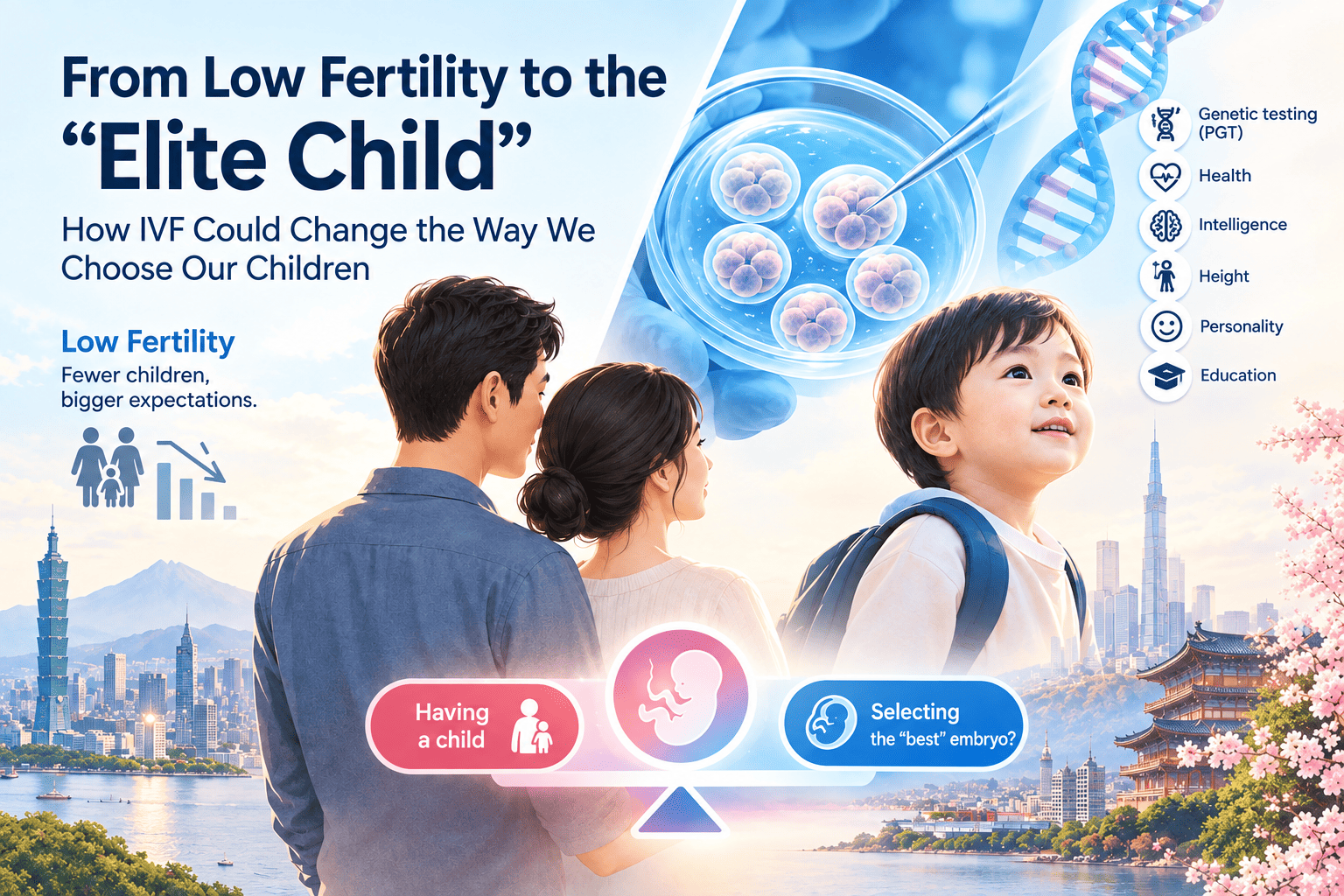
From raising the “best” child to selecting the “best” embryo?
This is where reproductive technology raises a new and difficult question.
IVF was originally developed primarily to help people overcome infertility. Today, however, IVF can also provide an opportunity to test embryos before implantation for certain genetic conditions. Advances in genomic technologies have further raised the possibility of selecting embryos according to increasingly complex genetic information.
Current technologies cannot simply create a “perfect” or “genetically superior” child. Complex characteristics such as intelligence, height, personality, and educational achievement are influenced by many genes as well as family environment, education, nutrition, socioeconomic circumstances, and chance.
Nevertheless, the possibility of selecting among embryos could gradually change parental expectations. If technology suggests that one embryo has a statistically greater probability of developing a particular characteristic, parents may feel pressure to choose it—even when the predictive power remains limited.
The concern, therefore, is not that IVF will suddenly produce “designer babies.” Rather, it is that reproductive decisions could gradually shift from having a child toward selecting which embryo is considered more desirable.
When “the best child” also means “a son”
The issue becomes even more complicated where son preference remains deeply rooted. Across parts of Asia, gender-biased sex selection has contributed to unusually high sex ratios at birth. The biological norm is approximately 105 boys for every 100 girls, yet substantially higher ratios have been documented in countries including China and Vietnam. The combination of son preference, declining fertility, and access to reproductive technologies deserves particular attention. When families intend to have only one or two children, preferences regarding the sex of those children may become especially consequential.
Importantly, an unusually high sex ratio at birth does not by itself tell us which technology was used. It can indicate gender-biased sex selection more broadly, but the pathways may include prenatal sex selection, abortion, reproductive technologies, or combinations of these factors. The broader concern is that reproductive technologies may reinforce existing social preferences. If parents already strongly prefer sons, technological advances could potentially make it easier to translate those preferences into reproductive decisions.
Thailand: a country worth watching
Thailand provides an especially interesting case. The country has experienced a prolonged decline in fertility and is now confronting rapid population ageing. At the same time, Thailand has developed a substantial reproductive medicine sector and has become an important destination for fertility treatment in the region.
This creates a striking demographic paradox:
- Thailand is facing one of the region's most serious low-fertility challenges while simultaneously developing into an important regional market for technologies that help people reproduce.
- IVF can provide enormous benefits to individuals and couples who wish to have children. However, the growth of ART should not be viewed as a simple solution to population decline. IVF can help individuals overcome infertility, but it cannot by itself reverse the social, economic, and cultural forces that lead people to have fewer children.
Thailand's position as a regional fertility-treatment destination therefore makes the country particularly relevant for discussions about the future of reproductive technologies. Developments in IVF, PGT, and emerging genetic technologies deserve attention not only from medical professionals and bioethicists, but also from demographers and population policymakers.
Could technology change the nature of the fertility crisis?
The traditional demographic question has been: Why are people having fewer children? We may increasingly need to ask another question: When people have fewer children, will they seek greater control over the characteristics of each child?
This is perhaps the most important demographic implication of the emerging technologies captured by the concept of “Confugenics”. The term refers to the intersection of Confucian values and emerging reproductive and genetic technologies, particularly the use of these technologies in the pursuit of an “ideal” child. If parents have only one child, they may feel that the stakes associated with that child's education, health, abilities, and future success are exceptionally high. Technological development could potentially amplify this pressure. Parents who already feel compelled to give their children every possible educational advantage may eventually feel similarly compelled to use reproductive technologies if these technologies are marketed as providing an additional advantage.
The danger is therefore not necessarily the creation of genetically “perfect” humans. It may be the gradual normalization of the idea that some embryos are more desirable than others.
The risk is social inequality and changing values
There is also a significant issue of inequality. Advanced reproductive and genetic technologies are expensive and may initially be accessible primarily to wealthier families. If their use becomes associated with educational or socioeconomic advantage, reproductive technology could potentially become another mechanism through which social inequalities are reproduced across generations.
There is also a danger that existing gender preferences could become embedded in new technologies. The concept of Confugenics raises concerns that technological enhancement could reinforce traditional gender biases and further disadvantage female offspring in societies where sons continue to be preferred.
For policymakers, the challenge is therefore not simply whether these technologies should be permitted or prohibited. It is also about how societies should define acceptable reproductive choice, prevent discrimination, and protect children from unrealistic expectations.
A new question for demographers
Demography has traditionally focused on how many children people have. The development of ART and reproductive genetic technologies may require us to think increasingly about which children people choose to have—and why. As East Asia confronts unprecedented low fertility and population ageing, the intersection of low fertility, intensive parenting, son preference, reproductive technology, and genetic selection deserves much greater attention.
The central question is no longer simply whether technology can help us have children. It is whether technology may eventually change the way we think about which children are worth having. That is the demographic, ethical, and social question that the concept of “Confugenics” invites us to consider.
For more information. Please read the article:
Chin, A. H. B., Rueda, J., Sun, N., Dang, T. N. H., Bosenge-Nguma, J. D., Nor, N. N. F. M., & Muhsin, S. M. (2025). Confugenics - East Asian culture favors uptake of human cognitive enhancement and IVF genetic technologies amid demographic challenges. Monash Bioethics Review, 43(1), 97–127. https://doi.org/10.1007/s40592-025-00244-3