As People Live Longer, Who Will Care for Whom?
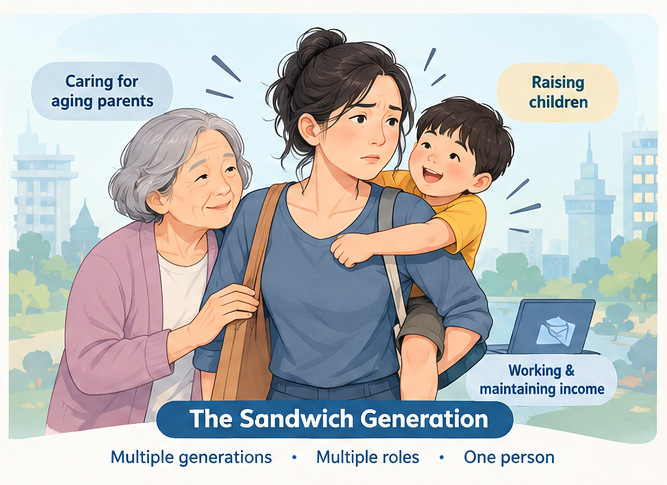
Increasing life expectancy is one of the greatest achievements of modern society. Yet as people live longer, a new question is becoming increasingly urgent: who will care for them when they need care? In many families, the answer remains their children. This has created a growing but often overlooked group: the “sandwich generation,” people who simultaneously have caregiving responsibilities for older parents and their own children.
The concept of the “sandwich generation” was introduced by Miller in 1981 to describe adults who are “sandwiched” between the care needs of two generations. However, society has changed considerably since then. People are living longer, marrying and having children later, while the period during which they may need to care for their parents is becoming longer. A person in midlife may therefore be raising children, supporting ageing parents, and maintaining employment and household income at the same time. The issue is not simply that they are caring for more people; it is that they are expected to perform multiple roles simultaneously.
A “Sandwich” More Diverse Than We Think
A recent scoping review synthesized 67 studies published between 1999 and 2024, covering 16 countries and five subregions of Asia. The findings show that the sandwich generation is far from a homogeneous group. Participants in the studies ranged in age from 18 to 67 years and included younger, middle-aged, and older adults; people living with or apart from their parents; migrants; widowed individuals; and people living in very different family circumstances.
This diversity matters for how we understand intergenerational caregiving. When we think about the “sandwich generation,” we should not assume that it refers only to a middle-aged woman simultaneously caring for an ageing parent and young children. In reality, being “in the middle” can occur at different stages of life and within different family structures. What matters is that one person is simultaneously responding to caregiving needs arising from multiple generations.
When Being “Caught in the Middle” Becomes Six Burdens
Across the 67 studies, the review identified six major burdens experienced by members of the sandwich generation. These burdens often overlap, meaning that the pressure of caring for different generations can affect physical health, emotional well-being, finances, relationships, and everyday life at the same time.
1. Physical Burden
Caring for ageing parents while raising children can be physically demanding. Daily tasks such as providing personal care, accompanying parents to healthcare services, managing household responsibilities, and looking after children can leave caregivers physically exhausted, particularly when care needs become more intensive.
2. Emotional and Psychological Burden
Emotional and psychological burden was the most frequently reported, appearing in 41 studies. Caregivers described stress, worry, guilt, anxiety, and emotional exhaustion as they tried to meet the needs of both older and younger family members. The feeling of being responsible for everyone can make it difficult to find time for their own emotional well-being.
3. Financial Burden
Supporting both older parents and children can place substantial pressure on household finances. Families may face costs related to healthcare, education, daily living, and caregiving, while caregivers may also have fewer opportunities to work or advance their careers. These pressures can make it difficult to plan for their own financial future.
4. Social Isolation
Caregiving can also change people’s social lives. When much of their time and energy is devoted to family responsibilities, caregivers may have fewer opportunities to meet friends, participate in community activities, or pursue personal interests. Over time, this can contribute to loneliness and a sense of social isolation.
5. Role Conflict
Members of the sandwich generation often have to manage several roles at once—as adult children, parents, partners, workers, and caregivers. These responsibilities can compete for the same limited time and energy. Balancing family care with employment and personal needs can therefore become a constant challenge.
6. Intergenerational Conflict
Intergenerational conflict was reported in 19 studies, making it an important and distinctive burden in the Asian context. Disagreements may arise over caregiving responsibilities, childrearing, family expectations, or the use of household resources. Thus, being “caught in the middle” is not only about caring for two generations—it can also mean navigating different expectations and negotiating relationships between them.
A Distinctive Burden in Asia: When Filial Piety and Conflict Coexist
These burdens need to be understood within the cultural and family contexts of different societies. In many Asian countries, caring for parents is not viewed simply as an individual responsibility but is also connected to norms surrounding family, obligation, and filial piety. In some East and Southeast Asian societies influenced by Confucian traditions, expectations surrounding filial piety, family hierarchy, and intergenerational obligations may shape how family members negotiate caregiving responsibilities. However, this does not mean that all Asian families are the same, nor does it mean that Confucianism itself causes conflict.
In fact, intergenerational conflict was reported in 19 studies and emerged as an important issue in the Asian context. Conflict may arise when different generations hold different views about childrearing, elder care, the distribution of responsibilities, or the use of family resources. This creates an important paradox: values that emphasize family responsibility and cohesion may also generate pressure when family resources are insufficient to meet all expectations. The review does not show that “Confucianism causes conflict.” Rather, it suggests that family norms and intergenerational obligations form an important part of the context in which negotiation, disagreement, and conflict take place.
When Caregiving Is No Longer Just a Family Matter
From a broader social perspective, the sandwich generation is not only a family issue but also a labour and economic issue. When caregivers have to divide their time among employment, children, and ageing parents, some may reduce their working hours, turn down career opportunities, or experience difficulties maintaining employment. This is particularly important in rapidly ageing societies, where the working-age population is shrinking and each working-age person becomes increasingly important to the economy.
If caregiving responsibilities cause workers to leave the labour market or substantially reduce the time they can devote to employment, the consequences extend beyond the household. They may affect household income, families’ ability to accumulate resources, and the labour supply of society as a whole. Therefore, the question surrounding the sandwich generation should not simply be “Who will care for older people and the children?” It should also be expanded to “Who is caring for those who care for older people and the children?”
Thailand: When the Sandwich Generation Becomes a Demographic and Economic Issue
This question is particularly important for Thailand, a country experiencing rapid population ageing. Thailand entered an “aged society” in 2024 and is expected to become a “super-aged society” by 2035. At the same time, Thailand’s total fertility rate was only 1.2 births per woman in 2024. These two trends are occurring simultaneously: the number of older people is increasing while the number of children and the share of the working-age population are declining.
Against this demographic backdrop, the sandwich generation may become an increasingly important population group. An adult may need to care for parents who live to very old ages while simultaneously raising one or two children, maintaining employment, and supporting other family members. This is not only a concern for the health sector or older-person services; it is also connected to the labour market, family policy, social protection, long-term care, and gender equality.
As the working-age population declines, members of the sandwich generation should not be viewed only as “caregivers.” They are also an important part of the labour force and the wider economy. Policies that support caregiving can therefore also function as policies that support employment and economic development. Possible approaches include direct support for caregivers, respite services, community-based care, long-term care, and family-friendly workplace policies.
For Thailand, it is important to prepare for this challenge before the burden becomes overwhelming. Demographers, sociologists, and policymakers need to view the sandwich generation as an issue at the intersection of population ageing, low fertility, the labour market, and social protection. When a society has more people who need care but fewer working-age people available to provide it, the question is not only how to provide better care for older people, but also how to protect those who provide that care.
Do Not Ask Only, “Who Will Care for Older People?”
One of the most important messages is that caregiving burdens can accumulate. A person may begin by caring for ageing parents, but that responsibility can subsequently affect their time, health, and employment. When income falls or career opportunities are constrained, financial pressure may increase; at the same time, limited time and stress can contribute to greater family conflict. In this way, different forms of burden do not exist in isolation but can become part of a cycle that is increasingly difficult to escape.
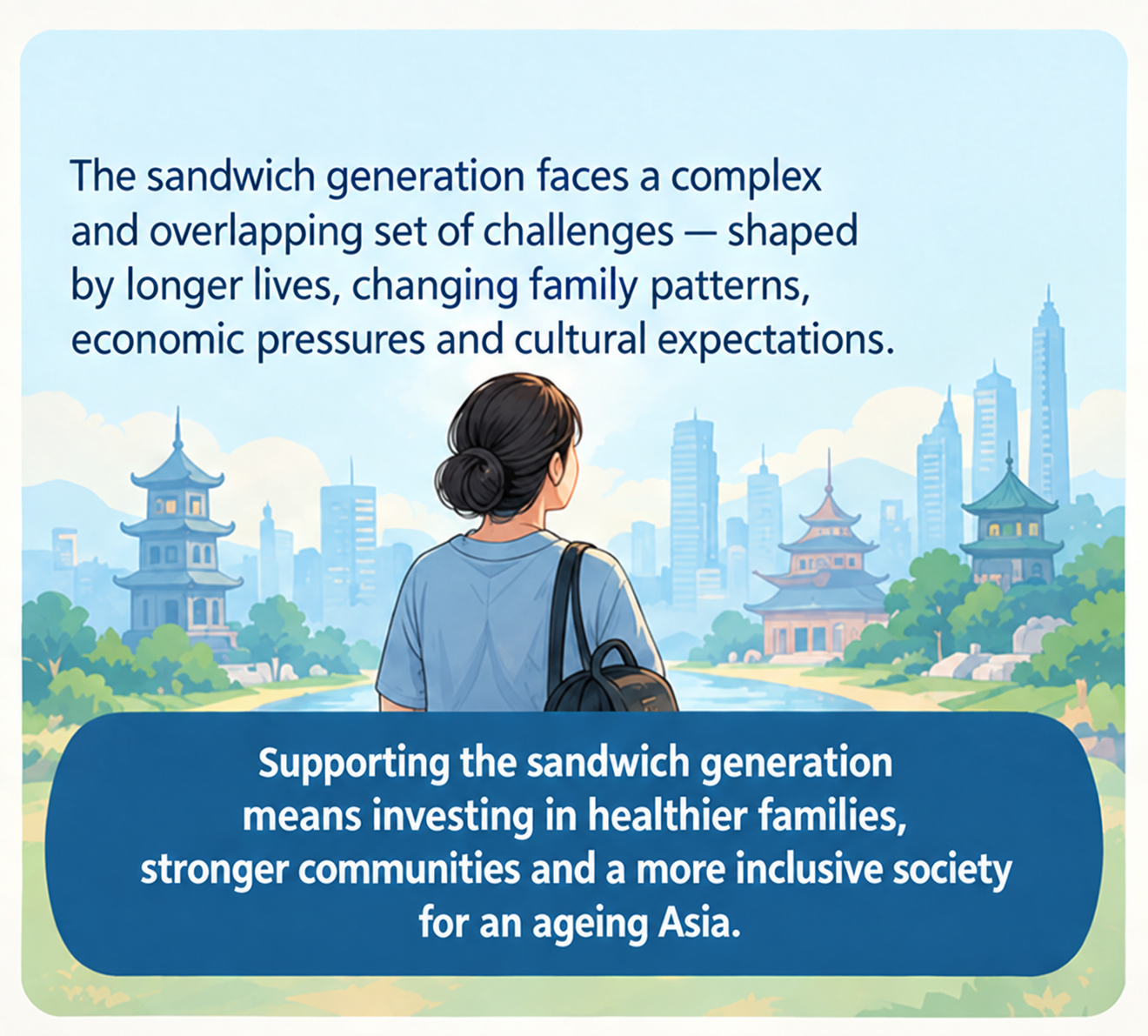
This is why policies addressing the sandwich generation cannot focus on only one dimension. Providing services for older people without supporting caregivers leaves an important part of the problem unaddressed. A society in which people live longer needs not only to strengthen its capacity to care for older people but also to protect those who provide that care.
Ultimately, the question should not only be “Who is caring for whom?” but also “Who is paying the price in their own time, health, income, and career opportunities?” If we want to prepare for an ageing society in which people live longer, we must ensure that the responsibility for care does not become the burden of one generation alone.
References
- Do, H. T. T., Sukontamarn, P., & Dang, T. N. H. (2026). Diversity and Intergenerational Caregiving Burdens of the Sandwich Generation in Asia: A Scoping Review. Journal of Intergenerational Relationships. https://doi.org/10.1080/15350770.2026.2726551
- Department of Older Persons. (2025). Situation of the Thai older persons report 2024. Ministry of Social Development and Human Security. https://www.dop.go.th/download/statistics/th1768287262-2583_1.pdf
- The World Bank. (2024). Fertility rate, total (births per woman) - Thailand. https://data.worldbank.org/indicator/SP.DYN.TFRT.IN?locations=TH