A Hidden Global Problem That Demands Greater Attention
Living longer is one of humanity’s greatest achievements. Advances in medicine, public health, nutrition, and living conditions have enabled people around the world to reach older ages. Yet, as populations age, an important question remains insufficiently addressed: are older people able to live their later years free from violence, exploitation, and neglect?
Elder abuse is a global public health and social concern. The World Health Organization estimates that approximately one in six people aged 60 years and older experience some form of abuse in community settings each year. Abuse can take many forms, including physical violence, psychological or emotional mistreatment, sexual abuse, financial exploitation, neglect, and the denial of dignity and autonomy. Its consequences can extend beyond physical injury to affect mental health, financial security, family relationships, and quality of life.

Despite its scale and consequences, elder abuse remains comparatively underrecognized in research, public discussion, and policy responses. Violence against women and child abuse have increasingly become subjects of public awareness campaigns, legal protections, and institutional intervention. Elder abuse, however, often remains hidden within households and relationships that are expected to provide care and protection.
This invisibility is not accidental. Abuse frequently occurs in private settings and may be perpetrated by people whom older adults trust or depend upon. Older people may fear losing essential care, damaging family relationships, experiencing retaliation, or becoming a burden to others if they disclose their experiences. Some may not even recognize certain behaviors as abuse, particularly when these behaviors have become normalized within family relationships.
Bringing elder abuse out of the shadows therefore requires more than identifying individual incidents. It requires a broader social recognition that older people have the same right to safety, dignity, autonomy, and protection as everyone else.
When Family Care Becomes a Source of Hidden Harm
The family is an essential source of care and support for older people in many societies. Adult children often provide financial assistance, companionship, help with daily activities, and emotional support. In many Asian societies, these responsibilities are reinforced by longstanding cultural expectations of filial piety, respect for parents, and intergenerational reciprocity.
These traditions can strengthen family solidarity and provide older people with a sense of belonging and security. However, the same expectations may also make elder abuse difficult to acknowledge and address.
Where family matters are widely regarded as private, mistreatment by relatives may be perceived as an internal family problem rather than a concern requiring social intervention. Older people may remain silent to avoid bringing shame upon their families, causing conflict between family members, or jeopardizing the support on which they depend. The expectation that children should care for their parents may also make it particularly difficult to admit that a child or another relative is causing harm.
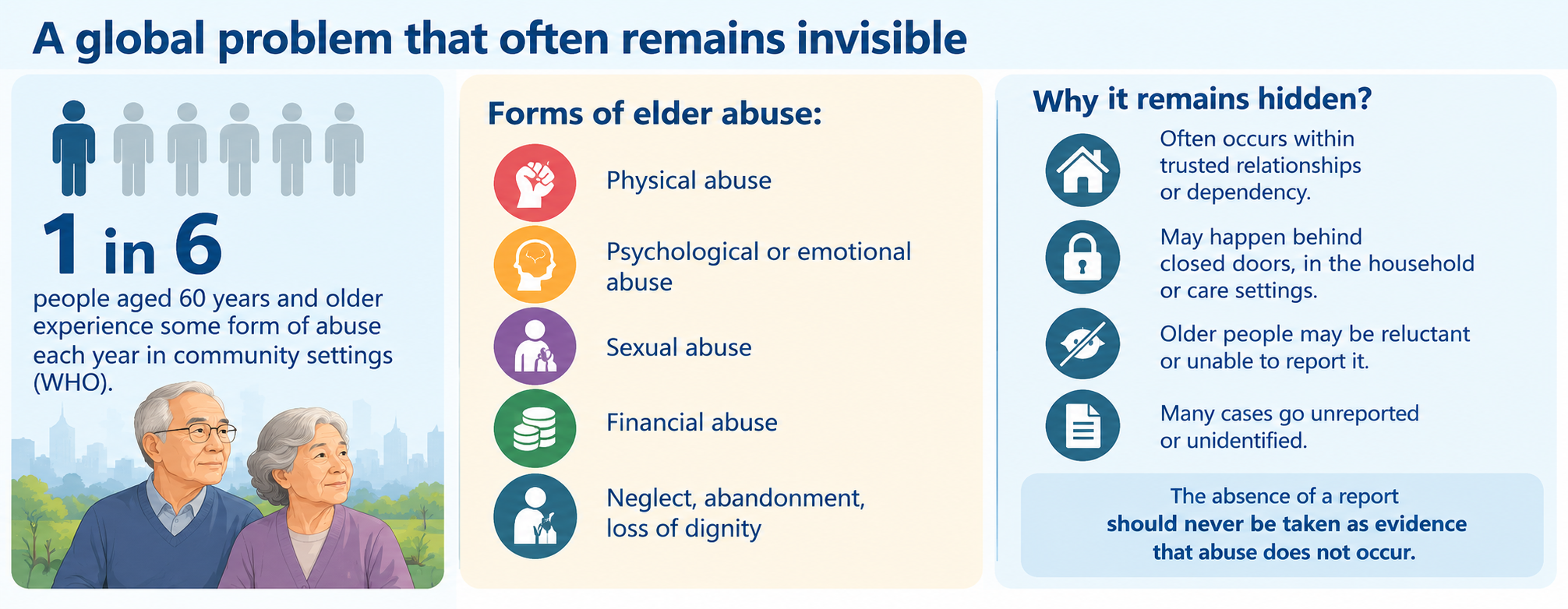
The problem becomes even more complicated when abuse does not involve obvious physical violence. Repeated humiliation, intimidation, exclusion from important family decisions, or the restriction of personal autonomy may be dismissed as ordinary family disagreements. Financial exploitation can be equally difficult to recognize. Money may be taken, pensions may be controlled, or financial decisions may be made without genuine consent under the guise of helping an older parent or managing household expenses. In some circumstances, older people may interpret such behavior as an expression of family obligation or affection rather than a violation of their rights.
These possibilities should not lead us to portray Asian families as inherently abusive or traditional values as inherently harmful. Rather, they highlight the need to distinguish genuine care from practices that undermine older people's dignity, autonomy, and well-being. Family solidarity should never require older people to tolerate mistreatment in silence.
What Research from Vietnam Reveals
Evidence from Vietnam illustrates how elder abuse can remain hidden within family relationships. Dang and Rukumnuaykit (2023) showed that 31.67% had experienced at least one form of physical or mental abuse by household members during the previous year, while mental abuse alone affected 31.55% and physical abuse 1.52%. Being ignored in major family decisions was particularly common, reported by approximately one-quarter of the older people in the sample. Importantly, higher educational attainment among children living in the same household was associated with lower risks of both mental and physical abuse. The study also identified particular vulnerabilities among older women, people aged 80 and above, those experiencing difficulty with daily activities, and older people living in urban areas. The findings also reinforce a broader concern: living with family does not automatically guarantee protection from harm.
The Vietnamese experience also highlights why elder abuse needs greater recognition as a public issue. In the traditional family system, living with adult children is often viewed as an important form of support for older parents. However, family co-residence can have both benefits and hidden costs. The same household that provides care, companionship, and economic support can also become the setting in which psychological or physical mistreatment occurs.
This does not mean that family-based care is inherently harmful. On the contrary, families remain an essential source of support for older people. The lesson is that family care should be supported rather than assumed to be sufficient. Older people need mechanisms through which abuse can be recognised, discussed, prevented, and addressed without placing them at greater risk.
Why Elder Abuse in Asia Must Become a Public Concern
Vietnam offers an important case through which to examine the social conditions that may make elder abuse difficult to recognize. In societies where filial responsibility and family reputation carry considerable weight, older people may feel a strong obligation to preserve family harmony, even when their own well-being is compromised.
Dependence can further complicate this situation. Older adults who rely on their children for housing, food, transportation, health care, or daily assistance may be reluctant to disclose mistreatment for fear of losing essential support. Others may believe that enduring difficult treatment is simply part of family life. Financial exploitation may be particularly difficult to identify when the boundaries between shared household resources, intergenerational support, and individual financial rights are unclear.
These concerns are not unique to Vietnam, nor should they be generalized to every Asian country. Asian societies differ substantially in their family structures, social protection systems, cultural values, and legal frameworks. However, the Vietnamese evidence provides a compelling reason to investigate how cultural expectations, economic dependence, and limited opportunities for disclosure may interact in different national contexts.
Greater public recognition is especially important because underreporting can make the problem appear less serious than it is. When older people remain silent, when family members regard mistreatment as a private matter, and when institutions lack effective mechanisms for recognizing abuse, the absence of visible cases can be mistaken for the absence of a problem.
Elder abuse must therefore be understood not only as a matter of individual behavior but also as a social issue involving power, dependency, family relationships, economic security, and the protection of human rights. Respect for family privacy should not become a justification for ignoring harm.
Bringing Elder Abuse into the Public Conversation
Bringing elder abuse out of the shadows begins with changing how societies understand ageing and care. Older people should not be viewed solely as recipients of assistance or as dependants whose well-being rests entirely in the hands of family members. They remain individuals with rights, preferences, resources, relationships, and the capacity to make decisions about their own lives.
First, public awareness must extend beyond physical violence. Communities need to recognize psychological mistreatment, exclusion from decision-making, neglect, coercion, and financial exploitation as potential forms of abuse. Awareness initiatives should help older people, families, and frontline professionals distinguish appropriate family support from behaviors that compromise an older person's autonomy or safety.
Second, older people need accessible and confidential opportunities to seek help. Health professionals, social workers, community organizations, and local authorities can play important roles in recognizing warning signs and providing support. Reporting mechanisms must be designed with sensitivity to the risks older people may face when the person causing harm is a family member. Responses should prioritize safety, informed choice, and protection from retaliation.
Third, governments and researchers need to invest in stronger evidence. More recent and comparable data are needed to understand the prevalence, forms, perpetrators, and consequences of elder abuse across countries. Research should pay greater attention to experiences that may remain hidden, including financial exploitation and the ways older people themselves understand and interpret mistreatment. Evidence from Vietnam can contribute to this broader agenda, but additional research in other Asian countries is essential to establish the similarities and differences between national contexts.
Finally, elder abuse must become a more visible part of discussions about population ageing, public health, gender equality, family well-being, and social protection. Preparing for ageing societies means more than expanding health services or ensuring that older people receive assistance with daily activities. It also means creating environments in which care is safe, respectful, and free from violence.
A Call to Bring Elder Abuse Out of the Shadows
Societies increasingly recognize that violence against women and child abuse are not merely private family matters. They are public concerns that require collective awareness, institutional responses, and sustained efforts at prevention. Elder abuse deserves the same seriousness and commitment.
The findings from Vietnam remind us that mistreatment can exist within households that are otherwise regarded as sources of care and protection. They also challenge the assumption that family co-residence automatically ensures older people's well-being. Although families remain indispensable to the lives of many older adults, family relationships alone cannot replace effective safeguards, public awareness, and accessible support.
As populations age across the world, the number of people who may require assistance from relatives, communities, and care services will continue to make the quality and safety of care an important social concern. The responsibility to protect older people cannot rest solely on individual families, nor should older adults have to choose between enduring mistreatment and risking the loss of essential support.
Bringing elder abuse out of the shadows means creating a society in which older people can speak without shame, seek help without fear, and live without having their dignity compromised. It means recognizing that abuse can occur even when it is concealed by affection, obligation, or family tradition. Most importantly, it means refusing to treat the suffering of older people as an inevitable or private consequence of growing old.
Living longer should mean more than adding years to life. It should mean having the opportunity to live those years with dignity, security, autonomy, and respect.
Reference:
Dang, T. N. H., & Rukumnuaykit, P. (2023). Elder Abuse by Household Members and Education of Elders’ Own Children Living in the Same Household: Empirical Evidence from Vietnam. Socius: Sociological Research for a Dynamic World, 9. https://doi.org/10.1177/23780231231196788